|
||||
Alpine Marine Services Pvt LtdPakistan Trade Bulletin Sustainability • Ports • Trade • Energy • Logistics • Policy |
||||
|
||||
 Falcon Oils Refinery in SindhAfter the CPEC Secretariat endorsed proposed project, Falcon Oils Refinery & Storage Complex at Dhabeji in Sindh's Thatta district has resolved the chief official obstacle. Proposed by Falcon Oils (Pvt) Limited, according to an Office Memorandum issued by the CPEC Secretariat, an anticipated a 100,000-barrels-per-day deep-conversion refinery with the development of 4 million tons of crude and petroleum-product storage capacity complex, 50MW captive power generation facility, and planned to produced Euro V compliant fuel to strengthen domestic refining capacity and reduce reliance on imported finished petroleum products. The project has already secured a Chinese technical and engineering partnership. The proposed project will be developed and financed entirely by private sponsors with no sovereign guarantee and no financial or other recourse to the Government of Pakistan. The proposed project has broader consequences for the country’s energy security. By increasing domestic deep-conversion refining capacity, the complex is intended to help shift a portion of the petroleum import bill away from finished products towards crude oil, while providing substantial additional storage capacity. |
||||
 Gulf of Aden Security Concerns Exaggerate as IMO Urges International ResponseInstantaneous international action called by the IMO, following by a regenerated surge in piracy incidents occurrences across the Gulf of Aden. The Gulf of Aden, a critical shipping corridor connecting Asia, Europe, and the Middle East. According to the recent reports, six vessels with more than 90 seafarers have been detained by pirates, stressing the escalated risk to maritime trade and crew safety. IMO Secretary-General stressed the urgent requirement of strengthened maritime security measures across the region to protect seafarer. He advised stakeholders including flag states, coastal nations, shipowners, and operators to implement industry best practices and follow IMO counter-piracy guidance to safeguard vessels and crews. The IMO also reaffirmed the commitment to support regional anti-piracy initiatives through the Djibouti Code of Conduct and the Jeddah Amendment while emphasizing the importance of sustained international naval cooperation. Global shipping risks are being continue to reshape by geopolitical tensions, the resurgence of piracy is a threat to maritime security and a critical priority for the international shipping community. |
||||
 Pak, Saudi Agriculture and Food Security Collaboration Reaches New MilestonePakistan and Kingdom of Saudi Arabia have strengthened the strategic economic corporation by establishing an ambitious goal to increase agricultural and food exports. Over the next two years, Pakistan’s agricultural and food exports to boost up to US$3 billion. The commitment was grasped in a recent visit by a high-level Saudi delegation to Islamabad, dedicated to boost alliance in agriculture, food security, trade, and investment. Both countries recognized crucial growth areas, including expanding imports of Pakistani rice, gradually doubling its purchases of red meat, fruits and fruit concentrates, green fodder, and water-efficient agricultural technologies with highlighted private-sector engagement, investment in agri-processing, and stronger business-to-business linkages. The initiative aligns with Saudi Arabia’s Vision 2030 objectives and positioning Pakistan as a dependable partner in supporting the Saudi Arabia long-term food security and sustainable agricultural development goals. |
||||
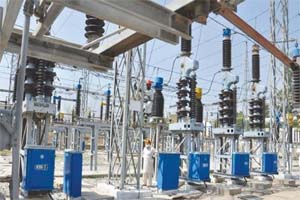 Pakistan’s Energy Sector - $5 Billion Refinery Upgrade Plan Signals New EraPakistan is all set to move in a new phase of energy sector transformation with an anticipated US$5 billion investment intended at modernizing the Pakistan’s refinery infrastructure. According to Petroleum Minister, in the coming months official investment contracts are expected to be signed, a move from preliminary commitments to actionable projects. The investment program is planned to upgrade Pakistan’s aging hydro-skimming refineries into modern deep-conversion facilities proficient of producing higher-quality, cleaner fuels with an improved operational efficiency. The initiative is supported by the government’s refinery policy and broader efforts to strengthen energy security and reduce reliance on imported petroleum products. In parallel, Pakistan with Turkish Petroleum is preparing to revive offshore oil and gas exploration, and expected to commence drilling activities in Pakistani waters later this year. These expansions are predicted to attract more foreign investment, increased native energy production, and promote the long-term sustainability and competitiveness of the Pakistan’s energy landscape. |
||||
 Potential Merger of Maple Leaf–Pioneer Poised to Reform Pakistan’s Cement IndustryPakistan’s cement sector might witness a momentous alliance as Maple Leaf Cement Factory Limited and Pioneer Cement Limited gauge a possible fusion that would shape one of the Pakistan’s prime cement manufacturers. Industry analysts be certain of the proposed unification would create a combined entity with around 13.4 million tons of annual production capacity, becoming the second-largest producer in northern Pakistan and amongst the top three countrywide. The prospective merger echoes a wider drift of merging within the cement industry, where companies are focused on operational efficiencies, improved marketplace positioning, and longstanding value creation rather than intensifying size in an already competitive market. Maple Leaf’s deliberate procurement of a governing stake in Pioneer Cement earlier this year laid the foundation for greater integration. If accepted, the merger is predictable to crack collaborations across production, distribution, and cost management while firming the joint company’s occurrence in the northern region. The expansion emphasizes the growing changing aspects in Pakistan’s industrial sector and the rising importance on scale, efficiency, and sustainable growth. |
||||
 Dredging Operations Gestures New Drive for Pakistan’s Blue EconomyKarachi Port has embarked a foremost dredging program meant at consolidation of Pakistan’s maritime infrastructure and refining trade competence. The project, commanded by National Dredging and Marine Services in collaboration with the Karachi Port Trust (KPT), concentrations on deepening key navigation channels, including the Karachi Harbor Approach Channel, Tipu Sultan Channel, and South Wharf Basin. The dredging program is intended to sustain finest channel depth, empowering the safe movement and berthing of larger vessels while developing overall port operations. The initiative is predictable to advance cargo handling capacity, aid smoother maritime traffic, and backing mounting worldwide trade volumes through Pakistan’s busiest seaport. An important objective of the project is to build regional dredging competences and lessen necessity on foreign service providers. By developing homegrown proficiency and firming maritime infrastructure, the initiative is anticipated to deliver long-term operational efficiencies, generate foreign exchange savings, and contribute to the growth of Pakistan’s blue economy. |
||||
 Sturdier Port-City Link, Community HealthcareThe consequence of strengthening the connection between ports and nearby urban communities have been highlighted by the Federal Minister for Maritime Affairs. Ports serves as a facilitator for economic growth, social development, and community well-being. Not only supporting supply chain, generating employment, tax revenues, logistics activity, and industrial growth, ports have a broader responsibility to support the communities directly impacted by their operations Reflecting this vision, Karachi Port Trust (KPT) organized its 35th free medical camp at Bhit Island under the theme “Healthcare Beyond Boundaries,” providing healthcare services to 513 residents, including men, women, and children. The initiative extended medical consultations, free medicines, laboratory testing, and hepatitis screening services, improving access to essential healthcare in underserved coastal areas. The program demonstrates the maritime sector’s growing commitment to inclusive development, reinforcing the role of ports as drivers of sustainable economic progress while enhancing the quality of life for coastal communities through meaningful social outreach and public health initiatives. |
||||
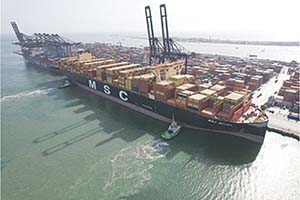 Mega Ship Honoring Turkiye Docks in KarachiKarachi Port has again exhibited its competence to accommodate the world’s ultra‑large container vessels with the arrival of MSC Turkiye, a 400-meter mega container ship, with volume for more than 24,000 twenty-foot equivalent units (TEUs). Operated by Mediterranean Shipping Company and Liberia-flagged, MSC Turkiye was built in China and named to honor the 100th anniversary of the founding of the Republic of Türkiye. According to the Karachi Port Trust (KPT), during its Karachi call around 1,600 container movements were planned. The arrival of the vessel comes as Pakistan pursues to progress its maritime infrastructure and expand the role of its Pakistani ports in international trade, with Karachi handling the bulk of the Pakistan’s seaborne commerce. |
||||
 |
||||
|
SHIP AGENCY - NVOCC - PORT OPERATIONS - TERMINAL OPERATIONS
Karachi - Port Qasim - Gwadar - Gadani
|
||||
| This bulletin is produced by Alpine Marine Services Private Limited for the exclusive use of our principals and business partners. Information is sourced from public maritime intelligence, government announcements, and industry reporting. This is not investment or legal advice. © Alpine Marine Services Private Limited 2026. All rights reserved. |